In 2008, when we opened Nota Bene, we made a decision that looked almost… backwards.
At the time, dining was drifting toward small plates and shareables. Fun, social, “try everything.” But in many rooms, the experience had started to feel diluted—less structure, less satisfaction. People left entertained, but not always fed.
So, we bet on something simple: re-center the meal. A clean structure. Appetizer, main, dessert. Done very well. Priced with restraint. Built on value, not theatrics. We weren’t trying to out-trend the trend. We were listening for what the cycle was about to want next.
That restaurant became one of the most successful in the city, and I’m still proud of it—not just because it worked, but because it reminded me of something I’ve seen again and again:
History repeats, but it rarely announces itself. It whispers in PATTERNS.
Patterns aren’t magic. They’re not predictions. They’re recognition—the ability to notice when today starts to rhyme with something you’ve already lived through.
This matters hospitality leaders because most costly decisions don’t fail at the decision. They fail earlier—when we misread the signals and move too fast.
You can see it in economics. You can see it in operations. And you can absolutely see it in your own business.
A simple example: labor.
There have been moments where hiring felt impossible—then suddenly teams were stable again—then COVID hit and the market flipped—then it shifted again. Each cycle creates a different power dynamic, a different candidate mindset, a different retention risk.
If you treat every hiring season as “unprecedented,” you’ll overreact.
If you treat it as a pattern, you’ll adjust with calm authority.
That’s the real advantage of pattern recognition: it helps you slow down, ask better questions, and stop confusing noise for signal.
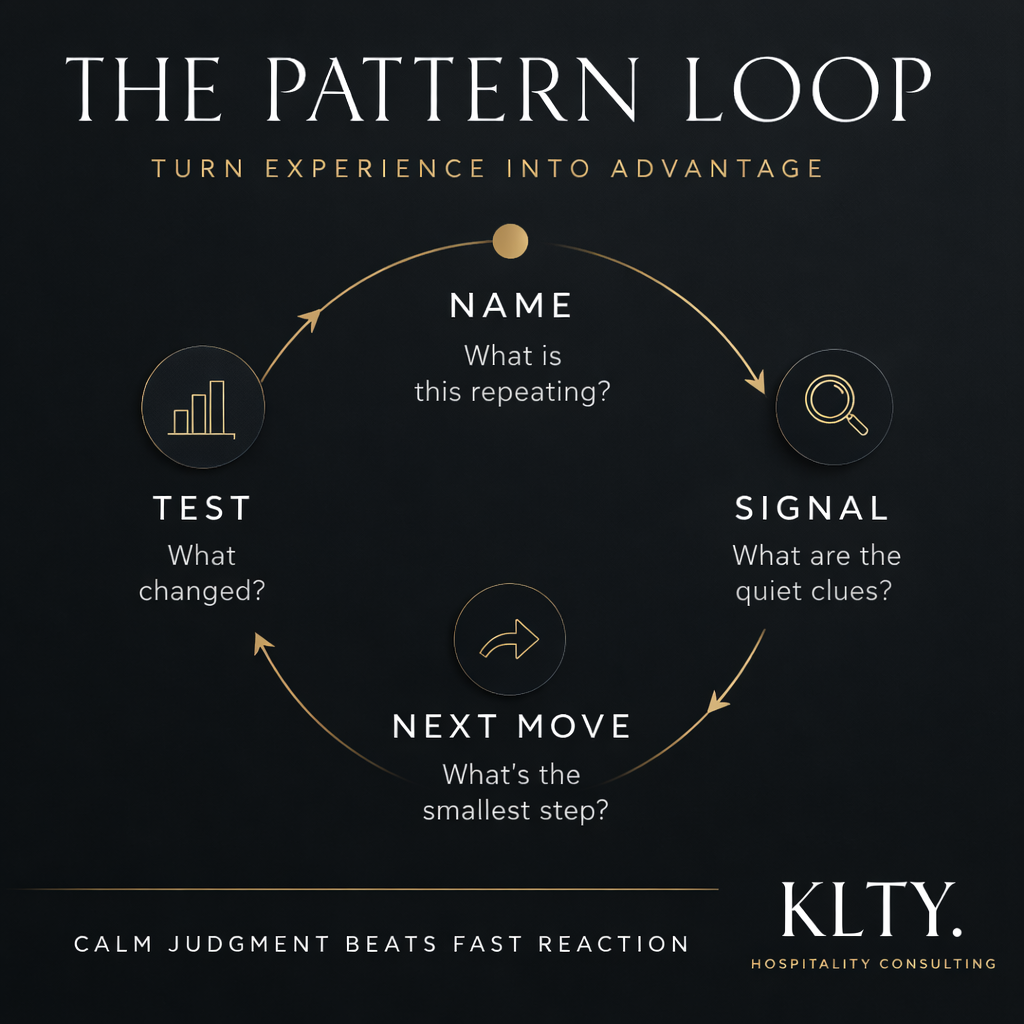
A practical loop:
1) Name the pattern
“This feels like a shift from novelty to clarity.”
“This feels like a market moving from employee-led to employer-led.”
“This feels like guests re-prioritizing value over variety.”
2) Identify the signals (not the stories)
What are guests asking for, repeatedly?
What are they hesitating on?
Where are complaints clustering?
What are your best people quietly reacting to?
3) Decide the “next small move.”
Not the grand strategy. The next reversible step.
A menu structure adjustment. A tighter hiring filter. A clearer service standard. A revised offer.
4) Test, then learn.
Watch the response. Keep what holds. Drop what doesn’t.
The goal isn’t to be right. It’s to become less surprised. Because the leaders who perform best under pressure aren’t the ones who move fastest.
They’re the ones who stay calm long enough to recognize what they’re looking at.
A prompt I’ve been using lately:
“What does this remind me of—and what did I wish I noticed sooner last time?”
If you’re leading a team or a business right now: what pattern do you think is returning in your world?